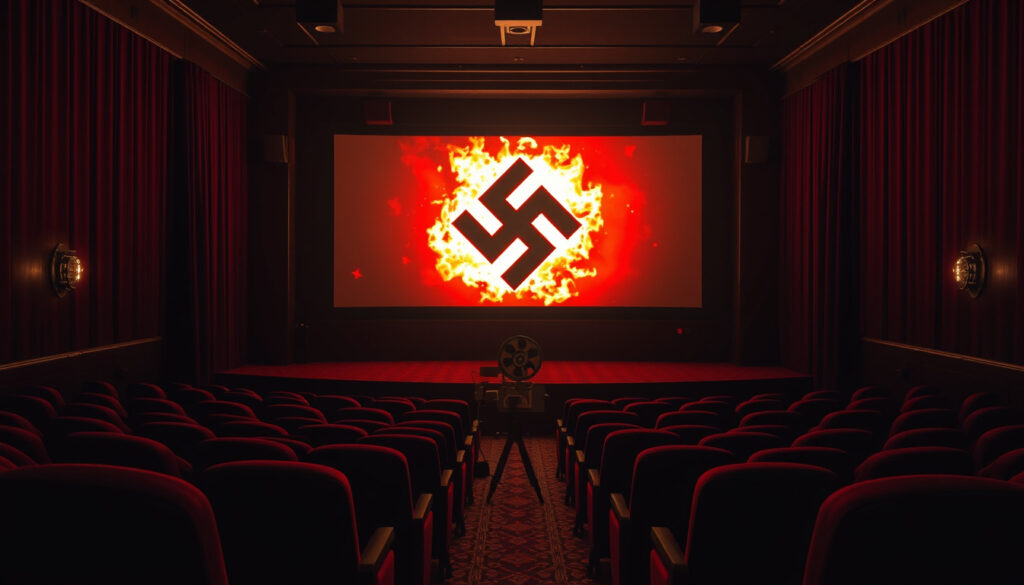
Inglourious Basterds: Iconic Scenes and Hidden Meanings Unpacked
Few films from the past fifteen years have sparked as much conversation as Quentin Tarantino’s Inglourious Basterds. Released in 2009 with a $70 million budget, it went on to earn over $321 million worldwide and holds an 89% score on Rotten Tomatoes (Wikipedia (film database)). Beyond the box office success, the film is packed with iconic scenes and layered meanings that reward repeated viewings.
Release year: 2009 ·
Director: Quentin Tarantino ·
Budget: $70 million ·
Box office: $321.5 million ·
Rotten Tomatoes: 89% ·
IMDb rating: 8.3/10
Quick snapshot
- Inglourious Basterds is a fictional alternate-history story (Wikipedia (film database)).
- The film was a commercial success, earning $321.5 million on a $70 million budget (Wikipedia (film database)). (Wikipedia (film database))
- Christoph Waltz won the Academy Award for Best Supporting Actor for his role as Hans Landa (Wikipedia (film database)). (Wikipedia (film database))
- The exact meaning of the three-fingers gesture remains debated among fans and critics. (Scribd (scene analysis document))
- Tarantino’s precise intention for the milk scene with Shoshanna is open to interpretation (Scribd (scene analysis document)).
- 2008 – Filming began (Wikipedia (film database)).
- 2009 – Premiere at Cannes Film Festival (Wikipedia (film database)).
- 2010 – Received 8 Academy Award nominations, including Best Picture (Wikipedia (film database)).
- Scholars continue to analyze the film’s satirical approach to WWII cinema and its influence on modern war films (Inquiries Journal (academic literary criticism)).
- The film remains a popular subject of video essays and podcast discussions (YouTube (video essay analysis)).
The key facts below confirm the film’s reach and reception across multiple metrics.
| Label | Value |
|---|---|
| Director | Quentin Tarantino (Wikipedia (film database)) |
| Release date | August 21, 2009 (Wikipedia (film database)) |
| Budget | $70 million (Wikipedia (film database)) |
| Box office | $321.5 million (Wikipedia (film database)) |
| IMDb rating | 8.3/10 (Wikipedia (film database)) |
| Rotten Tomatoes | 89% (Wikipedia (film database)) |
Is Inglourious Basterds a hit or flop?
The numbers are clear. With a budget of $70 million and a worldwide gross of $321.5 million, Inglourious Basterds tripled its investment at the box office (Wikipedia (film database)). Critical reception was equally strong: an 89% Rotten Tomatoes score and an 8.3/10 on IMDb place it among Tarantino’s highest-rated works. The film also earned eight Academy Award nominations, winning one for Christoph Waltz’s performance (Wikipedia (film database)).
By any commercial or critical yardstick, Inglourious Basterds is a hit. The trade-off: its alternate-history violence and stylized language have divided some audiences, yet that very divisiveness fuels its enduring cultural footprint.
The implication: the film’s success isn’t just financial. It reshaped how audiences and critics talk about war cinema, blending pop-culture references with high tension.
What are the famous lines from Inglourious Basterds?
Tarantino’s dialogue has a habit of seeping into the cultural lexicon, and Inglourious Basterds is no exception. Two lines, in particular, have become instantly recognizable.
- “That’s a bingo!” – Lt. Aldo Raine (Brad Pitt) delivers this line after successfully identifying a Nazi target. It has become shorthand for triumphant recognition in pop culture (Listen Notes (film discussion podcast)).
- “Au revoir, Shoshanna!” – Col. Hans Landa (Christoph Waltz) calls out this chilling farewell as Shoshanna escapes. The mix of politeness and menace captures Landa’s character perfectly (Scribd (scene analysis document)).
- “I love rumors! Facts can be so misleading.” – Landa’s line has been widely discussed as a meta-commentary on the film’s own relationship with historical truth (Listen Notes (film discussion podcast)).
- “I want my scalps!” – Aldo Raine’s rallying cry for the Basterds’ mission of revenge (Scribd (scene analysis document)).
What this means: these lines don’t just add flavor. They serve as anchors for the film’s core themes of identity, perception, and the rewriting of history. Each quote carries a double edge—humor and horror in equal measure.
Landa’s “I love rumors” line is the film’s philosophical spine. In a story that deliberately invents an alternate ending to WWII, Tarantino questions who gets to decide what counts as fact.
The implication: Tarantino uses dialogue to blur the line between truth and performance, forcing the audience to question every claim.
What do three fingers mean in Inglourious Basterds?
The three-fingers gesture appears when the Basterds signal to each other. Aldo Raine holds up three fingers, and his men respond in kind. The meaning has sparked debate among fans.
What is the significance of the three-finger gesture?
- Identification signal: The gesture is used by the Basterds to verify allies in tense situations, such as the basement tavern scene (Medium (film analysis essay)).
- Reference to the Three Stooges: Tarantino has acknowledged the influence of classic comedy on his work. The three fingers are a playful nod to the Three Stooges’ slapstick and disguise humor (YouTube (video essay analysis)).
- Cinema-as-language: According to analysis from the University of Michigan journal (film studies publication), Tarantino often employs visual references to construct a self-aware narrative. The gesture, like the film’s chapter cards, signals a constructed story rather than a naturalistic one.
The pattern: what looks like a simple hand sign is actually a layered cinematic homage. It’s Tarantino saying, “This is a movie, and we’re playing with the rules.”
Why does Landa order her milk?
In the now-famous strudel scene, Hans Landa orders a glass of milk for Shoshanna after sitting down at her café. The moment is loaded with subtext.
The milk order is a test. Landa knows Shoshanna is Jewish (she is hiding under a false identity), and he deliberately orders milk—a non-kosher beverage when combined with a meat meal—to gauge her reaction. Shoshanna’s calm refusal of the strudel (she claims she isn’t hungry) further hints at her fear of revealing her identity (Scribd (scene analysis document)). The scene establishes Landa’s manipulative nature: he enjoys the hunt more than the capture.
Why couldn’t Shoshanna eat the strudel?
Shoshanna’s refusal to eat the strudel is likely driven by her kosher dietary restrictions. Adding whipped cream to the strudel (which contains dairy) with a meat meal would violate kosher rules. But the more immediate reason is fear: she knows Landa is the Jew Hunter and any slip could expose her (Scribd (scene analysis document)).
Landa’s milk order is a perfect example of weaponized politeness. He uses manners as a psychological scalpel. Shoshanna’s survival depends on reading his moves correctly—and the tension is unbearable because the audience knows the stakes.
The trade-off: this scene is a masterclass in building suspense through everyday actions. It also underscores the film’s larger theme—language and gesture as tools of control.
What does Hans Landa yell?
During Shoshanna’s escape from the farmhouse in the opening scene, Landa yells “Au revoir, Shoshanna!”—a phrase that echoes throughout the film (Scribd (scene analysis document)). The bilingual line (French for “Goodbye, Shoshanna”) illustrates his multilingual cunning and his theatrical flair.
What does SS mean in Inglourious Basterds?
The initials SS stand for Schutzstaffel, the Nazi paramilitary organization. In the film, Landa wears the uniform and insignia of an SS officer. The historical SS was responsible for many war crimes, and Tarantino uses Landa’s SS identity to maximize the character’s villainous weight (Wikipedia (film database)).
Landa’s language choices—switching between French, English, and German—are deliberate. He uses linguistic superiority as a form of intimidation. In the tavern sequence, his fluency in different languages enables him to catch characters in contradictions (Medium (film analysis essay)).
Why this matters: Landa isn’t just a villain; he’s a performer. His yell is a curtain call for his own evil charisma. The film’s title itself, with its deliberate misspelling, reinforces the idea that words are flexible—and that history can be rewritten as theatrically as a script.
One striking pattern across these five questions: nearly every iconic moment in Inglourious Basterds involves a character using language—or a gesture—to assert power. The film turns dialogue into a weapon, and that’s what makes it unforgettable.
The character comparison below illustrates how each protagonist wields a distinct form of combat.
| Character | Actor | Primary motivation |
|---|---|---|
| Lt. Aldo Raine | Brad Pitt (Wikipedia (film database)) | Revenge through Nazi scalps and terror |
| Col. Hans Landa | Christoph Waltz (Wikipedia (film database)) | Intellectual domination and self-preservation |
| Shoshanna Dreyfus | Mélanie Laurent (Wikipedia (film database)) | Survival and eventual revenge through cinema |
Three characters, one pattern: each uses a different form of combat—muscle, intellect, and cinema—to fight the same war.
Confirmed facts
- Inglourious Basterds is a fictional alternate history (Wikipedia (film database)).
- The film was a commercial success (Wikipedia (film database)).
- Christoph Waltz won an Oscar for his role (Wikipedia (film database)).
What’s unclear
- The exact meaning of the three-fingers gesture is debated (YouTube (video essay analysis)).
- Tarantino’s intention for the milk scene remains open to interpretation (Scribd (scene analysis document)).
Quotes from the film
“I love rumors! Facts can be so misleading.”
Col. Hans Landa, Inglourious Basterds
“That’s a bingo!”
Lt. Aldo Raine, Inglourious Basterds
“Au revoir, Shoshanna!”
Col. Hans Landa, Inglourious Basterds
These three lines capture the film’s tonal range: Landa’s philosophical irony, Raine’s raw American bravado, and Landa’s theatrical menace. Each speaker embodies a different approach to the war—and to the movie itself.
Editor’s note: These quotes are drawn from the film’s screenplay and widely cited in fan discussions and academic analyses.
For viewers who enjoy films that blend satire with historical revisionism, Inglourious Basterds remains a touchstone. The choice to watch it—or rewatch it—is rewarded with new layers every time. But the real takeaway is this: Tarantino’s film dares you to ask who gets to tell history, and whether truth is ever as clean as a fact sheet.
listennotes.com, medium.com, screenrant.com, spoilertown.com
The film’s tension is masterfully driven by Christoph Waltzs Oscar-winning performance as the chilling Colonel Hans Landa.
Frequently asked questions
How rich is Christoph Waltz?
Christoph Waltz’s net worth is estimated at around $20 million, according to celebrity wealth trackers. His Oscar win for Inglourious Basterds significantly boosted his profile and earnings.
What is Tarantino’s lowest rated film?
Among Tarantino’s films, Death Proof (2007) holds the lowest Rotten Tomatoes score, at 67%. Inglourious Basterds is among his highest-rated works.
Who is the main character in Inglourious Basterds?
There is no single main character. The film follows multiple protagonists: Shoshanna Dreyfus, Lt. Aldo Raine, and Col. Hans Landa. The narrative structure intertwines their stories.
What is the significance of the title?
The misspelled title “Inglourious Basterds” (instead of “Inglorious Bastards”) is a deliberate artistic choice. It signals that the film is not a historical documentary but a stylized, alternate-history fantasy. The misspelling also nods to Italian “spaghetti” war films from the 1970s.
Is Inglourious Basterds based on a true story?
No. The film is a complete work of fiction. While it references real WWII figures and events, the assassination of Nazi leadership by cinema fire is entirely invented.
What happened to Shoshanna at the end?
Shoshanna dies in the cinema fire she sets, along with Hitler and the Nazi high command. Her final moment is shown in black-and-white, a stylistic choice that underscores the film’s genre-bending nature.
How long is the film?
The runtime of Inglourious Basterds is 2 hours and 33 minutes (153 minutes).
Related reading
More related posts
 Cast Of Moana 2
 LG 43 Inch Smart TV Review: Models, Prices & Issues
 Cast of Primeval: Full List of Actors and Characters (2007-2011)
 Cast Of Superman 2025
 Cast Of Superstore (tv Series)
Cast Of Final Destination Bloodlines
Cast Of Superstore (tv Series)
Cast Of Final Destination Bloodlines
 Who Played Cho Chang? Katie Leung’s Harry Potter & Bridgerton
 Lady Chatterley’s Lover 2022: Controversy, Explicitness & Guide