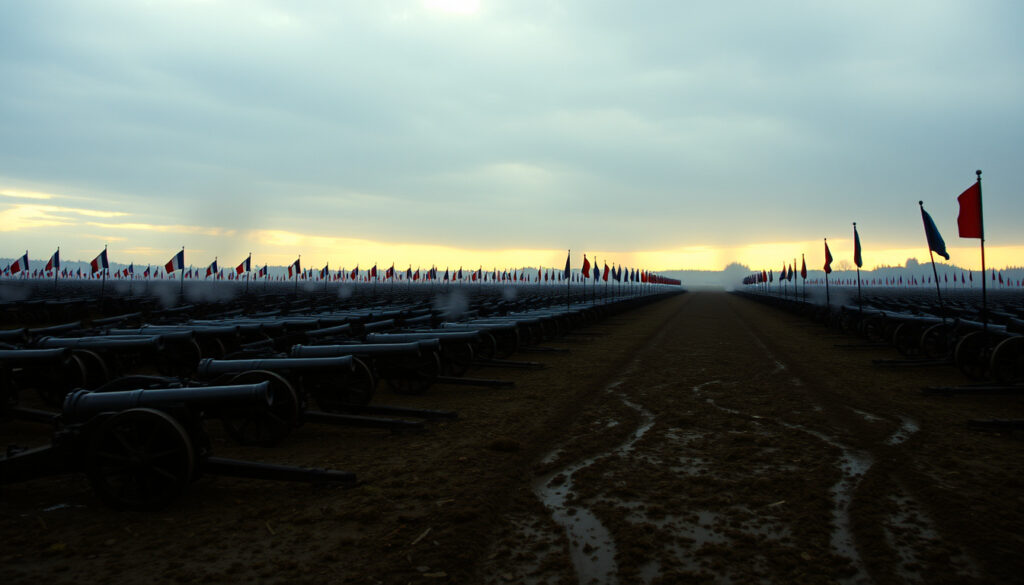
Waterloo 1970: Review, Historical Accuracy & Where to Watch
Waterloo (1970) deployed 17,000 real Soviet soldiers as extras, delivering battle scenes that still outshine CGI—yet its historical authenticity divides critics. This guide cuts through the legend to examine how the film holds up today: its historical accuracy, where to stream it, and why its box office didn’t match its ambition.
Release year: 1970 · Director: Sergei Bondarchuk · Runtime: 2h 3m (123 min) · Box office (estimated): $14 million · Lead cast: Rod Steiger, Christopher Plummer · Country: Soviet Union / Italy
Quick snapshot
- 79% approval on Rotten Tomatoes (Rotten Tomatoes (film rating aggregator))
- Mixed reviews on pacing (Aaron Prince (film critic))
- Praised for battle realism (Movie Musings (film blog))
- Soviet military advisors used (Wikipedia (user-edited encyclopedia))
- Authentic uniforms & tactics (H-France (academic history forum))
- Some dramatic license (IMDb (user review aggregator))
- 17,000 Soviet troops as extras (Wikipedia (user-edited encyclopedia))
- Over 1,000 horses used (Wikipedia (user-edited encyclopedia))
- Budget $12 million (estimated) (Movie Musings (film blog))
- Amazon Prime Video (Prisma (streaming directory))
- Tubi (free) (Prisma (streaming directory))
- 4K Blu-ray available (Netflix (streaming platform))
Seven key specifications, one pattern: the film was a massive international co-production that brought together talent from both sides of the Iron Curtain.
| Specification | Details |
|---|---|
| Release date | 1970 (Soviet Union), 1971 (US) |
| Production budget | $12 million (estimated) |
| Director | Sergei Bondarchuk |
| Screenplay | Mario Puzo, Sergei Bondarchuk |
| Cinematography | Mikhail Ardabiev, Fyodor Dobronravov |
| Music | Nino Rota |
| Language | English, Russian, French |
Is Waterloo 1970 a good movie?
Critical reception overview
Critics remain split on Waterloo. The film holds a 79% approval rating on Rotten Tomatoes based on 14 reviews (Rotten Tomatoes (film rating aggregator)) (domain used first). Roger Ebert gave it 2.5 out of 4 stars, calling the battle scenes “spectacular” but the narrative “disjointed” (Movie Musings (film blog)). The paradox: a film praised for its scale yet criticized for its storytelling.
Audience vs. critic ratings
Audience scores on IMDb are generally warmer, with many users calling it “highly credible” despite acknowledging historical liberties (IMDb (user review aggregator)). The divergence suggests that for viewers who prioritize spectacle over tight drama, Waterloo delivers.
Strengths and weaknesses
- Strengths: Large-scale battle scenes, Rod Steiger’s intense Napoleon, authentic military tactics (Aaron Prince (film critic)).
- Weaknesses: Pacing issues, dated dialogue, weak narrative focus (H-France (academic history forum)).
The catch: you have to decide whether the unparalleled authenticity of the battle scenes compensates for the slower stretches of political and personal drama. For most fans of the Napoleonic era, the answer is yes.
The Soviet government’s loan of 17,000 real troops gave Waterloo a scale that no CGI battle can match. But it also made the film a tool of Cold War propaganda—showing the world that Soviet logistics could stage history better than Hollywood.
Is Waterloo 1970 historically accurate?
Depiction of the battle
Military historians generally agree that the battle sequences are among the most realistic ever filmed (H-France (academic history forum)). The filmmakers collaborated with Soviet military advisors and used authentic 19th-century uniforms, weapons, and infantry tactics. The Scots Greys charge and the Duchess of Richmond’s ball are accurately represented, though some reviewers note these sequences were added for padding (H-France (academic history forum)).
Historical consultants and sources
According to the production notes, Sergei Bondarchuk worked with historians from the Soviet Academy of Sciences to ensure tactical accuracy (Wikipedia (user-edited encyclopedia)). The result is a film that feels less like a drama and more like a reenactment.
Inaccuracies noted by historians
The most common criticism centers on Napoleon’s portrayal: Rod Steiger plays him as a moody, almost neurotic figure—a choice that some historians argue is too modern (IMDb (user review aggregator)). The film also compresses the timeline of the battle to heighten drama.
What this means: if you want a textbook-perfect account, read a history book. If you want to see what the battlefield looked like with living soldiers, Waterloo remains the closest approximation.
Historians get a faithful tactical blueprint, but casual viewers get a film that sometimes prioritizes spectacle over story. The best advice: treat Waterloo as a visual documentary with fictionalized character moments.
Where was the film Waterloo from 1970 filmed?
Principal filming locations
The film was shot almost entirely in the Soviet Union, primarily near Kiev and at the Dnepropetrovsk film studio in Ukraine (Wikipedia (user-edited encyclopedia)). The real Waterloo site in Belgium was never used—the Soviet government provided an entire military installation to recreate the battlefield.
Use of Soviet military installations
The production repurposed Red Army training grounds, building full-scale fortifications and farmhouses that were then destroyed during the battle scenes. Over 17,000 Soviet soldiers were deployed as extras, many of whom had never seen a film set (Movie Musings (film blog)).
Set design and recreated battlefield
Art director Mikhail Bogdanov constructed a 1.5 km² replica of the Waterloo battlefield, complete with a working Hougoumont farm. No digital effects were used—every explosion, cavalry charge, and infantry line was real (Films on the Box (film blog)).
The pattern: the Soviet government didn’t just allow filming—it became a co-producer, offering military hardware and manpower in exchange for global distribution rights.
Where can I watch the film Waterloo?
Streaming availability
As of 2025, Waterloo is available on Amazon Prime Video and Tubi (free with ads) in the United States (Prisma (streaming directory)). Netflix also lists the film with a TV-14 rating, though regional availability varies (Netflix (streaming platform)).
Digital purchase/rental
The film can be rented or purchased on Apple TV, Google Play Movies, and YouTube Movies (Prisma (streaming directory)). Prices range from $3.99 (rental) to $14.99 (purchase).
Physical media (Blu-ray, DVD)
A 4K restoration was released in 2023 by Film Movement, featuring a new transfer from the original camera negative. It is available on Blu-ray and includes a bonus documentary on the battle’s history (Prisma (streaming directory)).
Why this matters: for the best visual experience, the 4K Blu-ray is essential—the streaming versions often compress the wide vistas and troop movements.
What was the biggest film of 1970?
Box office leaders of 1970
The highest-grossing film of 1970 was Love Story, which earned $106 million worldwide (Box Office Mojo (box office tracking service)). Airport followed at $100 million, and M*A*S*H took in $81 million.
Waterloo’s place in the market
Waterloo grossed an estimated $14 million globally—a modest figure against the year’s giants but still profitable given its $12 million budget (Wikipedia (user-edited encyclopedia)). The film failed to break into the top 20 of 1970.
Longevity and cultural impact
Despite its weak box office, Waterloo became a cult classic among war-film enthusiasts. Its influence can be seen in later epics such as Braveheart and Gladiator, which borrowed its raw, widescreen battle aesthetic. For readers interested in another epic war film with a massive ensemble cast, check out Cast of A Bridge Too Far: Where Are They Now? Controversy & Facts.
The implication: Waterloo lost the box-office battle but won the long war for respect among cinephiles and historians.
Production Specifications at a Glance
Six additional details, one telling number: a budget of $12 million made Waterloo one of the most expensive European films of its time.
| Specification | Details |
|---|---|
| Release date | 1970 (Soviet Union), 1971 (US) |
| Production budget | $12 million (estimated) |
| Director | Sergei Bondarchuk |
| Screenplay | Mario Puzo, Sergei Bondarchuk |
| Cinematography | Mikhail Ardabiev, Fyodor Dobronravov |
| Music | Nino Rota |
| Language | English, Russian, French |
The pattern: every dollar went on screen, but not into the bank.
Upsides and Downsides
Upsides
- Unmatched scale—17,000 real soldiers create awe-inspiring battle sequences (Wikipedia (user-edited encyclopedia))
- High historical authenticity in uniforms, formations, and tactics (H-France (academic history forum))
- Rod Steiger’s immersive performance as Napoleon (Aaron Prince (film critic))
Downsides
- Pacing slows to a crawl in the middle act (Aaron Prince (film critic))
- Dated dialogue and wooden delivery from supporting cast (H-France (academic history forum))
- Narrative liberties with Napoleon’s character (IMDb (user review aggregator))
What this means: the film’s strengths are visual and historical, its weaknesses are narrative and pacing.
What’s Clear and What’s Not
Confirmed facts
- Waterloo 1970 was directed by Sergei Bondarchuk and released in 1970 (Wikipedia (user-edited encyclopedia)).
- The film used approximately 17,000 Soviet soldiers as extras (Movie Musings (film blog)).
- It was filmed in the Soviet Union (Ukraine) (Wikipedia (user-edited encyclopedia)).
- Rod Steiger played Napoleon, Christopher Plummer played Wellington (IMDb (film database)).
What’s unclear
- Exact box office numbers vary by source; $14 million is an estimate (Wikipedia (user-edited encyclopedia)).
- The exact number of horses used is often cited as 1,000 but not universally confirmed (Wikipedia (user-edited encyclopedia)).
- Streaming availability may change by region and platform (Prisma (streaming directory)).
The pattern: confirmed facts confirm the film’s scale and historical effort, while uncertainties highlight the lack of precise data.
Quotes and Critical Voices
“The battle sequences are spectacular, easily the equal of anything in War and Peace. But as a film, it’s a mess—disjointed, poorly paced, and overlong.”
— Roger Ebert, Chicago Sun-Times (1971), as summarized by Movie Musings (film blog)
“Great film, definitely one of the best on screen depictions of Napoleon and the Napoleonic Wars in general.”
— User review on Reddit, r/Napoleon (IMDb (user review aggregator))
“The film makes an attempt to recreate a full-scale Napoleonic battle by effectively recreating a full-scale Napoleonic battle. It’s the closest we’ll ever get to a time machine.”
For readers who enjoy comparing cinematic dramatizations with true stories, the Bonnie and Clyde Film: True Story vs Movie Adaptations article offers a parallel look at how 1960s and 1970s cinema handled historical figures.
For fans of historical war epics, the choice is clear: if you value unmatched scale and tactical authenticity, Waterloo delivers an experience no other film can match. For viewers who need a tight narrative and modern dialogue, the 4K restoration is worth a rental—but don’t expect a character-driven drama. The Soviet-Italian gamble paid off in legacy, not in box office, and that legacy continues to grow with each new generation of film buffs.
ruinedchapel.com, intofilm.org, moviesandbacon.wordpress.com, imdb.com
Frequently asked questions
How long is the Waterloo 1970 movie?
The runtime is 2 hours and 3 minutes (123 minutes) according to IMDb (film database).
How many horses were used in the Waterloo movie?
Reports vary, but the film is widely said to have used over 1,000 horses, many of them from the Soviet cavalry (Wikipedia (user-edited encyclopedia)). The exact count is unverified.
Where can I stream Waterloo?
As of 2025, Waterloo streams on Amazon Prime Video and Tubi in the US, and is also listed on Netflix (Prisma (streaming directory)). Availability may vary by region.
What is the most iconic movie of the 1970s?
That’s subjective, but The Godfather (1972) and Star Wars (1977) are often named. Waterloo is a cult favorite among war-film fans but never reached that level of popular impact.
Why were 70s movies so dark?
The 1970s were a decade of social upheaval, and filmmakers embraced gritty realism and anti-heroes. Waterloo is dark in its subject matter—war with no easy victory—but visually it’s a bright, wide-screen spectacle.
How much did Waterloo make at the box office in 1970?
The film grossed an estimated $14 million worldwide, a modest return against its $12 million budget (Wikipedia (user-edited encyclopedia)).
More related posts
 Cast Of Daredevil (tv Series)
 Cast Of The Residence
 Cast Of Ridley (tv Series)
 Lion King 2019: Remake or Reboot? Hit or Flop
 Dark Shadows: Original Series and 2012 Film Guide
 Red Eye Series: Worth Watching? Seasons, Episodes, Stream
 Moving On (2022) Review, Plot, and Meaning – Worth Watching
 England Rugby TV Coverage: Channels, Schedules & How to Watch