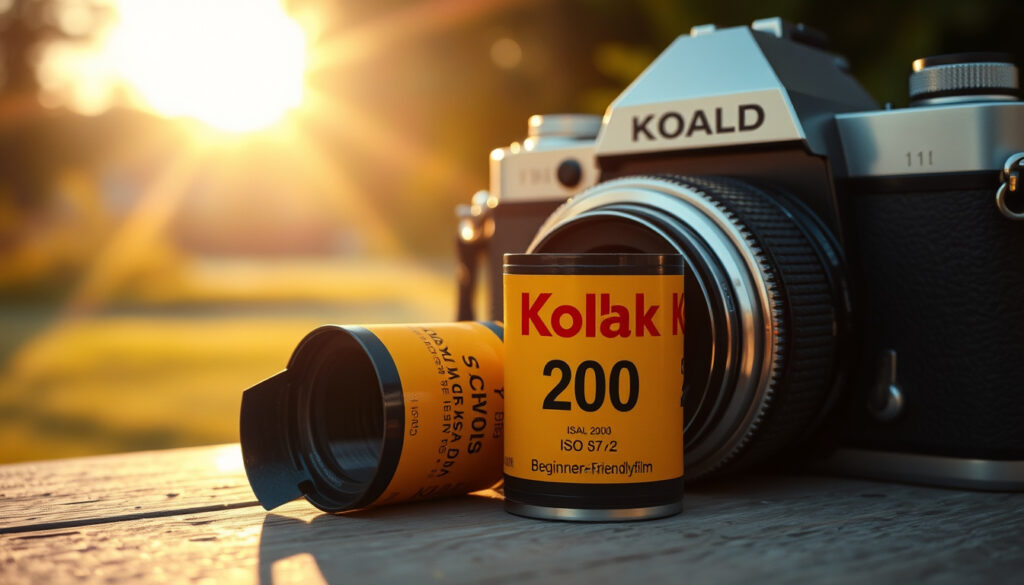
Kodak Gold 200: What It’s Good For, Speed, and Beginner Tips
Anyone who’s picked up a film camera for the first time in the last few years has probably seen the yellow box. But understanding exactly where it shines and where it struggles can save you rolls of disappointing shots—especially when the clouds roll in.
Film speed: ISO 200 —
Process: C-41 color negative —
Format: 35mm —
Exposures per roll: 36 in standard retail rolls —
Color balance: Daylight-balanced
Quick snapshot
- ISO 200, daylight-balanced color negative film (Film Processing (specialist film lab resource))
- Processed with C-41 chemistry (Film Processing)
- Standard 35mm roll with 36 exposures (Film Processing (specialist film lab resource))
- Exact global production volumes and regional availability
- Whether the current formulation is identical to older Gold stocks
- Precise manufacturing continuity across Kodak’s business changes
- November 2025: Kodak introduced new packaging for Gold 200 and Ultramax 400 (Kosmo Foto (film industry specialist))
- Gold 200 remains in active distribution through multiple retail channels (Kosmo Foto (film industry specialist))
- Expect continued availability with the new branding and packaging rollout
- Potential for price increases as Kodak consolidates its consumer film lineup
Here is a quick reference to the core specifications of Kodak Gold 200.
| Specification | Value |
|---|---|
| Film type | Color negative |
| ISO | 200 |
| Process | C-41 |
| Format | 35mm |
| Exposures per roll | 36 |
| Color balance | Daylight-balanced |
What is Kodak Gold 200 good for?
The short answer: it’s a consumer-grade daylight film. Kodak Gold 200 is a medium-speed, daylight-balanced color negative film developed with the C-41 process, aimed at everyday outdoor photography Film Processing. It delivers vivid color saturation, fine grain, and high sharpness in bright conditions.
When should you use Kodak 200?
- Bright sunny days: ISO 200 thrives in direct sunlight. At f/8 and 1/250th shutter speed, you get crisp handheld shots.
- Outdoor portraits: The warm color palette renders skin tones with a nostalgic red and yellow bias.
- Travel and everyday scenes: It’s lightweight, affordable, and available in 36-exposure rolls—enough for a day out.
Standard retail rolls are 35mm with 36 exposures.
For a casual shooter who only clicks the shutter on sunny weekend afternoons, Kodak Gold 200 delivers exactly what it promises: consistent, warm-toned negatives with no surprises.
The film’s broad exposure latitude, reported by Kodak at up to two stops underexposure and three stops overexposure, means you have some room for metering mistakes Kosmo Foto.
The implication: treat Gold 200 as a specialist for controlled lighting, not a general-purpose film. If the sun is out, it’s hard to beat the price-to-quality ratio.
Is Kodak Gold 200 or 400 better?
Six facts, one pattern: ISO is a trade-off between speed and grain. ISO 400 is twice as sensitive as ISO 200, but the extra sensitivity comes with larger silver halide crystals and visibly more grain.
What does the ISO number mean?
ISO 200 is half as sensitive as ISO 400 under the same light. Doubling the ISO gives you one extra stop of shutter speed or aperture—enough to shoot in open shade or overcast conditions without flash. ISO 400 gives more flexibility in cloudy or shaded conditions.
Kodak Gold 200 vs Kodak Ultramax 400
Here is how Kodak Gold 200 and Kodak Ultramax 400 compare on key attributes.
| Attribute | Kodak Gold 200 | Kodak Ultramax 400 |
|---|---|---|
| ISO | 200 | 400 |
| Grain | Finer, smoother detail | More visible grain |
| Best lighting | Bright sun, daylight | Mixed, cloudy, indoor with flash |
| Color profile | Warm, saturated with rich reds/yellows | Vivid, slightly grainer consumer look |
| Exposure latitude | Broad (±2 stops under, ±3 stops over) | Good (±1–2 stops) |
| Price per roll (approx.) | Lower | Slightly higher |
Gold 200 is generally described as having finer grain and smoother detail than Ultramax 400. Ultramax 400 is more versatile in mixed, indoor, cloudy, or lower-light shooting than Gold 200. A 2023 comparison from Shoot It With Film found that Ultramax 400 handled sun and shade very well when shot at box speed Shoot It With Film (film photography community resource).
For a beginner who only shoots outdoors in bright light, Gold 200 is the safer bet: less grain, lower cost, and more forgiving latitude. For someone who wants one film that works in sunshine and clouds, Ultramax 400 is the logical upgrade.
Do they still make Kodak Gold 200?
Yes. Retailer listings on the SERP still offer Kodak Gold 200 as a current 35mm film. Kodak Gold 200 is commonly sold as a 36-exposure roll, and it remains available from multiple camera stores rather than being a discontinued niche product.
Kodak Gold 200 35mm film
- Format: 35mm standard rolls
- Exposures: 36 per roll (standard retail)
- Packaging: Updated in November 2025 with new branding from Kodak Kosmo Foto
- Availability: Widely stocked at major retailers and specialist film shops
What this means: Kodak is actively investing in the Gold line—not sunsetting it. The packaging refresh in late 2025 signals continued production and distribution.
Is Kodak Gold 200 good for beginners?
Five considerations, one recommendation: yes, but with a daylight caveat.
ISO 200 is manageable for bright outdoor shooting, which reduces beginner exposure mistakes. Consumer color negative film like Kodak Gold 200 is designed to be easy for casual photographers—it rewards sloppy metering with usable negatives. Auto-exposure cameras can make Kodak Gold 200 usable for beginners in most daytime scenes.
Is 200 or 400 film better for beginners?
For beginners, the choice depends on lighting conditions. ISO 400 is more forgiving in mixed light because it needs less light, but it also shows more grain. ISO 200 encourages beginners to think about light—a useful discipline.
A new shooter loading Gold 200 into a point-and-shoot and expecting clean indoor party photos will get a roll of dark, muddy negatives. The film is not broken; the light contract was violated.
The trade-off: for a first roll, consider buying either a 3-pack of Gold 200 for outdoors or a single roll of Ultramax 400 that can handle a mixed first day.
Why is Kodak Gold so popular?
Kodak Gold is a long-running consumer film line with wide name recognition. The product description emphasizes vivid color saturation and fine grain, and Lomography’s archive shows more than 460,000 photos taken on Kodak Gold 200 35mm. That scale is rare for any single film stock.
Is Kodak Gold the best film?
Popularity does not mean it is objectively the best film. Comparison to Portra and Ultramax is needed for a complete picture. Kodak Portra 400, for example, is the professional portrait standard with finer grain and neutral skin tones—at roughly double the price per roll.
Kodak Gold 200 sample photos
Gold 200 is commonly characterized by warm, saturated tones with a nostalgic look, especially rich reds and yellows. The film’s color profile leans heavily into the red end of the spectrum, which makes sunsets, autumn leaves, and brick streets pop. Skin tones gain a warm glow that many photographers associate with the 1990s family album look.
Ultramax 400, by contrast, is often characterized as having vivid color saturation and a slightly grainer consumer-film look than Gold 200. In a side-by-side comparison, Gold 200 tends to preserve highlight detail better, while Ultramax 400 holds shadow detail with its extra speed.
The 460,000+ sample photos on Lomography aren’t just numbers; they’re a crowdsourced portfolio. For a new film buyer, that library is a better starting point than any product description.
The pattern: Kodak Gold’s popularity is a self-reinforcing cycle—the more people shoot it, the more sample photos exist, the more confident new buyers feel. But popularity does not equal universal suitability.
Can I use Kodak Gold 200 on a cloudy day?
Cloudy days work, but lower light means the camera needs a slower shutter, wider aperture, or flash. At ISO 200, a cloudy afternoon might require 1/60th at f/4 which is workable with a steady hand but not ideal for moving subjects.
Is Kodak Gold 200 good for indoors?
Daylight-balanced film can produce a color cast in indoor tungsten light unless corrected or flash is used. Under warm house lighting, expect a strong yellow-orange shift that may or may not be desirable. Flash restores neutral color and adds enough light for a correct exposure at the film’s base ISO.
Is Kodak Gold 200 suitable for night photography?
ISO 200 is less sensitive than ISO 400 or 800, so night photography without additional light is difficult. At night, even a wide-open lens at f/1.4 and 1/30th shutter may produce underexposed negatives unless the scene is brightly lit by streetlights. Flash becomes essential for any subject beyond ambient-lit cityscapes.
Kodak Gold 200 can be used indoors with flash or under strong daylight-simulating light. A hot-shoe flash or built-in camera flash will freeze motion and neutralize the tungsten color cast.
What this means for a weekend shooter: if you mostly take pictures at brunch, in living rooms, or at evening events, pay the small price premium for Ultramax 400. You’ll recover shots without flash that ISO 200 would lose.
Upsides
- Warm, nostalgic color palette with rich reds and yellows
- Very fine grain for a consumer-grade film
- Broad exposure latitude (±2 stops under, ±3 stops over)
- Lowest price among Kodak color negative 35mm films
- Widely available in 36-exposure rolls
- Beginner-friendly in bright daylight conditions
Downsides
- Too slow for indoor or cloudy shooting without flash
- Daylight balance creates strong color cast under tungsten light
- Not suitable for night photography without external light
- Grainier than professional films like Portra 400
- Less versatile than Ultramax 400 for mixed lighting
- Limited to 35mm format (no medium format 120 rolls)
myfavouritelens.com, kosmofoto.com, casualphotophile.com, dpreview.com, jonmullin.com, bluemooncameracodex.com, culturedkiwi.com, dcfever.com, witandfolly.co, petapixel.com
Frequently asked questions
Does Kodak Gold 200 work with any 35mm film camera?
Yes. Kodak Gold 200 is standard 35mm film and fits any 35mm camera that accepts commercial 35mm film cassettes.
Where can I buy Kodak Gold 200?
Major online retailers, local camera shops, and specialist film stores stock Kodak Gold 200 as a standard product.
Does Kodak Gold 200 require C-41 development?
Yes. Kodak Gold 200 uses the C-41 color negative process, which is the most widely available color film development standard.
Is Kodak Gold 200 the same as Kodak ColorPlus 200?
No. While both are ISO 200 color negative films, ColorPlus 200 is a different emulsion aimed at the budget market, typically with slightly higher contrast and warmer tones.
How long does an unopened roll of Kodak Gold 200 last?
When stored in a cool, dry place, unopened Kodak Gold 200 generally lasts 2 to 5 years past its expiration date with minimal color shift or base fog.
What is the difference between Kodak Gold 200 and Kodak Portra 400?
Portra 400 is a professional-grade film with finer grain, neutral skin tones, and more exposure latitude, but it costs roughly twice as much per roll as Gold 200.
For the casual shooter who fills a camera during weekend walks and family gatherings, Kodak Gold 200 is a fine choice. For anyone planning indoor events, evening parties, or travel that mixes sun and shade, the choice is clear: grab Ultramax 400 and save your Gold 200 rolls for the beach.
More related posts
 Cast Of Happy Gilmore
 Zoe Perry Movies: Filmography, TV Shows, and Personal Life
 Cast Of Lost (tv Series)
 Cast of Clue (1985): Full List of Actors and Characters
 Cast Of Succession
 Madame Web Flop Explained: Box Office & What Went Wrong
 Cast Of Never Have I Ever
 Colony: Definition, Historical Examples, and TV Facts