Bridge of Spies: Filming, Streaming, True Story & Spy History
Some Cold War films age into museum pieces; this one still plays like a live nerve. Steven Spielberg’s 2015 drama Bridge of Spies dramatizes the 1962 exchange of Rudolf Abel for Francis Gary Powers on Berlin’s Glienicke Bridge, and it earned Mark Rylance an Oscar for Best Supporting Actor; along the way, the movie leaves out a much messier spy story — the Cambridge Five, Anthony Blunt, Kim Philby — and that omission is worth as much attention as the film itself.
Rotten Tomatoes Score: 91% Certified Fresh (Rotten Tomatoes) ·
IMDb Rating: 7.6/10 (IMDb) ·
Academy Awards: 1 win — Best Supporting Actor, Mark Rylance (Oscars) ·
Worldwide Box Office: $165.6 million (Wikipedia) ·
Director: Steven Spielberg (IMDb) ·
Release Year: 2015 (IMDb)
Quick snapshot
- Whether MI5 shaped Blunt’s immunity deal is still argued (Wikipedia).
- Whether Queen Elizabeth knew about Blunt before 1979 is unresolved (Wikipedia). (Wikipedia)
- Whether Nicholas Elliott let Philby escape is debated (Wikipedia).
- The real exchange took place in February 1962 (Wikipedia).
- The film premiered in 2015 (IMDb).
- Streaming availability changes by country and over time; check a live tracker before subscribing (Reelgood).
- If you want the rest of the spy story, the film’s omissions point toward Philby and Blunt (Wikipedia).
Seven quick facts, one pattern: a prestige studio production with a compact budget and a heavy awards tail.
| Label | Value |
|---|---|
| Full Title | Bridge of Spies |
| Director | Steven Spielberg (IMDb) |
| Screenplay | Matt Charman, Ethan Coen, Joel Coen (IMDb) |
| Release Date | October 16, 2015 (US) (Wikipedia) |
| Running Time | 2h 21m (IMDb) |
| Budget | $40 million (Wikipedia) |
| Box Office | $165.6 million (Wikipedia) |
Where did they film Bridge of Spies?
Principal photography began September 8, 2014, and the production moved between New York, Germany, Poland, and California (Wikipedia).
- Production bases: Brooklyn (DUMBO, Astoria, Brooklyn Heights), Studio Babelsberg in Potsdam, Berlin Tempelhof Airport, Wrocław, Beale Air Force Base, and Berlin-Rummelsburg railway facilities (IMDb locations).
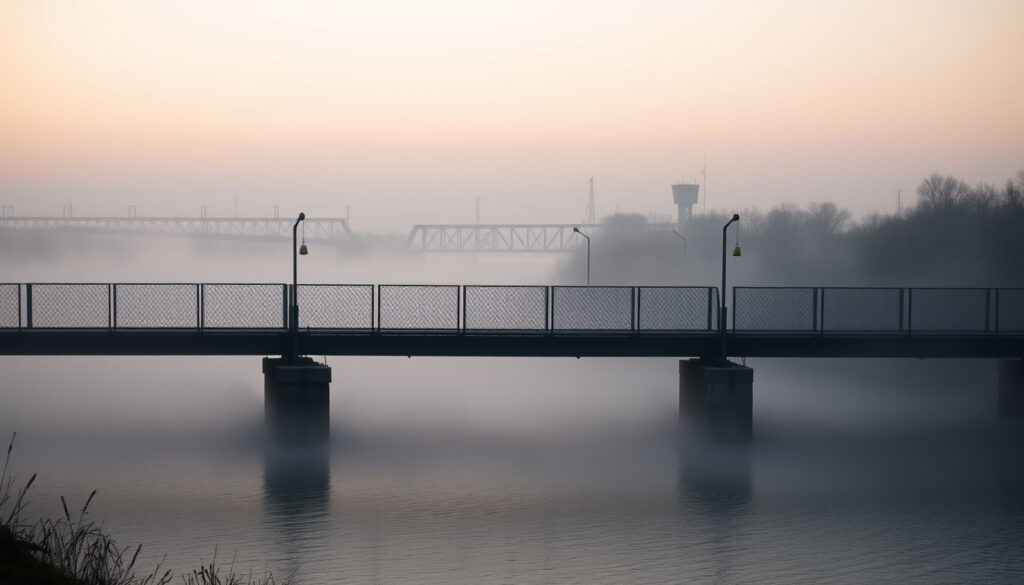
The most important location was the Glienicke Bridge itself, where the prisoner-exchange sequence was shot — the same bridge used in the real 1962 swap (IMDb locations). Brooklyn streets were dressed to look like 1960s New York, giving the film’s opening a period texture that CGI could not have matched.
The pattern: the film’s physical settings are mostly the real thing; the liberties show up in the timeline and the omissions.
How to watch a Bridge of Spies?
Streaming availability changes by country and shifts often. Reelgood’s tracker shows Bridge of Spies moving through different catalogs in the US, UK, Australia, Canada, and New Zealand, so a quick check beats an outdated recommendation (Reelgood).
- US options have included Netflix, Amazon Prime Video, Apple TV, Google Play, and YouTube (Reelgood).
- DVD and Blu-ray copies are still widely available through physical and online retailers.
The catch: a movie’s digital shelf moves around more than its theatrical release ever did.
Is Bridge of Spies a good movie?
What did critics say about Bridge of Spies?
- Rotten Tomatoes: 91% Certified Fresh (Rotten Tomatoes)
- Metacritic: 75/100 (Metacritic)
- The Guardian’s Peter Bradshaw called it “an elegant, intelligent slice of popular entertainment that peppers its gripping intrigue with winning wit and humour” (The Guardian).
The critical consensus treats Bridge of Spies as a restrained, confident throwback — a film that trusts performances instead of chasing action beats. Mark Rylance’s quiet, precise Abel is the reason the movie works.
What is the audience reaction?
- Rotten Tomatoes audience score: around 85% (Rotten Tomatoes)
- IMDb user rating: 7.6/10 (IMDb)
The broad shape of the audience scores points the same way: strong but not unanimous. Some viewers find the pacing stately; most still admire the craft.
Why this matters: the film’s reputation rests on control rather than spectacle, which is exactly why it has held up.
What happened to Rudolf Abel in Bridge of Spies?
In the film, Abel is caught with spy equipment, convicted, and later swapped for Francis Gary Powers on the Glienicke Bridge. In the real record, Abel returned to the Soviet Union, was decorated with the Order of Lenin, and was not prosecuted again (Wikipedia).
Did Donovan and Abel ever meet again?
The film gives them a meaningful last exchange, but the available record shows James Donovan and Rudolf Abel never met again after the swap (Wikipedia).
The implication: the bridge ending is emotionally earned but dramatically invented.
Why was Blunt not prosecuted?
The short answer is an immunity deal. Anthony Blunt, a Soviet spy inside British intelligence, confessed in 1964 and was not prosecuted in exchange for a full account of his work (Wikipedia). The film leaves out that entire scandal.
What happened to Sir Anthony Blunt?
- Blunt was an art historian and Surveyor of the Queen’s Pictures (Wikipedia).
- He admitted being recruited as a Soviet agent and gave a full confession in 1964 (Wikipedia).
- He was publicly named as a spy by Margaret Thatcher in 1979 (Wikipedia).
Why did Margaret Thatcher expose Anthony Blunt?
- Thatcher told the House of Commons in 1979 that Sir Anthony Blunt had been a Soviet spy (Wikipedia).
- The announcement ended roughly fifteen years of concealed immunity (Wikipedia).
Did Queen Elizabeth know about Anthony Blunt?
Whether or when the Queen was told about Blunt remains contested; Wikipedia’s account treats the matter as unproven rather than settled (Wikipedia).
Blunt reportedly kept his position for years after his confession, and his knighthood was not removed until after the 1979 exposure (Wikipedia).
Did Anthony Blunt lose his knighthood?
- Yes. After Margaret Thatcher’s 1979 statement, Blunt’s name was removed from the Order of the Bath (Wikipedia).
Why this matters: Bridge of Spies omits Blunt almost entirely, which keeps the film’s moral universe clean. The real intelligence world was full of deals and secrets.
Who was the biggest mole in British intelligence?
Most accounts give that title to Kim Philby (Wikipedia). Philby was the most damaging Soviet agent inside MI6 and a member of the Cambridge Five spy ring.
- Philby defected to the Soviet Union in 1963 (Wikipedia).
- He had penetrated British intelligence at a senior level for decades (Wikipedia).
- Anthony Blunt, by contrast, was a talent-spotter and courier within the same ring (Wikipedia).
The trade-off: the film’s decision to ignore the Cambridge Five may be good drama, but it gives a cleaner picture than the evidence supports.
Did Nicholas Elliott let Philby escape?
Nicholas Elliott, a close friend and MI6 officer, was sent to Beirut to confront Philby in January 1963. After several days of freedom, Philby vanished and turned up in Moscow (Wikipedia). Whether Elliott deliberately left the door open remains one of the most argued questions in British intelligence history.
The catch: because Elliott was both interrogator and friend, his actions will always be read through two contradictory lenses.
Bridge of Spies vs. real history
Three scenes where the film shifts the record, one pattern: each change makes a murkier story cleaner.
| Element | What the film shows | What the records say |
|---|---|---|
| Powers’ U-2 shootdown | Plane hit by a volley of three missiles | Hit by the first missile; more than 14 were launched (Wikipedia) |
| Frederic Pryor’s arrest | Detained near the Berlin Wall during its construction | Pryor disputed the details and said he was not crossing the Wall during its construction (Wikipedia) |
| Donovan’s background | A dedicated Brooklyn lawyer | Donovan had served as general counsel of the OSS during World War II (Wikipedia) |
The implication: the film makes choices — it does not fake a happy ending, but it tightens a messy record into a tidy narrative.
Bridge of Spies: the real timeline
The sequence below follows Wikipedia’s account of both the film and the historical case.
- July 1957 — Rudolf Abel arrested by FBI in New York (Wikipedia).
- October 1957 — Abel convicted and sentenced to 30 years (Wikipedia).
- May 1960 — Francis Gary Powers shot down in a U-2 over the USSR (Wikipedia).
- August 1960 — Powers sentenced to 10 years in Soviet prison (Wikipedia).
- February 1962 — Abel and Powers exchanged on the Glienicke Bridge (Wikipedia).
- 1963 — Kim Philby defects to the USSR (Wikipedia).
- 1979 — Margaret Thatcher exposes Anthony Blunt (Wikipedia).
- 2015 — Bridge of Spies premieres (Wikipedia).
What this means: the movie compresses two decades of spy history into one tight screen story.
What’s confirmed, what’s still unclear
Confirmed facts
- Abel was exchanged for Powers on the Glienicke Bridge (Wikipedia).
- James Donovan represented Abel pro bono (Wikipedia).
- Bridge of Spies is a dramatization, not a documentary (Wikipedia).
What’s unclear
- Whether Nicholas Elliott deliberately allowed Philby to escape (Wikipedia).
- Whether Queen Elizabeth knew about Blunt before 1979 (Wikipedia).
- The exact mechanics of Blunt’s immunity deal (Wikipedia).
The pattern: the confirmed events are mostly about the bridge; the unresolved questions are about the spies the movie never names.
Key quotes
“An elegant, intelligent slice of popular entertainment that peppers its gripping intrigue with winning wit and humour.”
— Peter Bradshaw, film critic, The Guardian
“Would it help?”
— James Donovan, as portrayed in Bridge of Spies (2015), IMDb
The pattern: the critics praise restraint; the film’s most quoted line refuses to say much at all.
The takeaway
Bridge of Spies succeeds because it trusts quiet performances and real locations. Its limits show up in the omissions: no Anthony Blunt on the stand, no Philby escape debate, no messy immunity deal. For anyone using the film as an entry point to Cold War history, the decision is clear: enjoy it, then follow the names the credits don’t explain. For film lovers, the choice is just as clear: see it at least once for Mark Rylance’s Abel, then read a history of the Cambridge Five if you want the rest of the story.
streamfind.com, reelgood.com, ast.wikipedia.org, stream-tracker.com, flixpatrol.com, imdb.com
Frequently asked questions
Is Bridge of Spies based on a true story?
Yes, it dramatizes the real exchange of Rudolf Abel for Francis Gary Powers in 1962. It also compresses time and drops the Cambridge Five subplot (Wikipedia).
Who plays Rudolf Abel in Bridge of Spies?
Mark Rylance plays Rudolf Abel and won the Best Supporting Actor Oscar for the role (Oscars).
Where can I stream Bridge of Spies for free?
“Free” depends on your existing subscriptions. Reelgood shows whether Netflix, Amazon Prime Video, or Apple TV includes it in your region; catalogs change often (Reelgood).
What is the Bridge of Spies about in one sentence?
An American lawyer defends a Soviet spy and later negotiates the spy’s exchange for a downed U-2 pilot (Wikipedia).
How accurate is Bridge of Spies compared to real history?
The broad facts are accurate; several details are compressed, including the number of missiles fired at Powers’ plane and the timing of Frederic Pryor’s arrest (Wikipedia).
Did Tom Hanks meet the real James Donovan?
No documented meeting appears in the cited sources. James Donovan died in 1970, before Hanks began acting.
Why is the movie called Bridge of Spies?
The title comes from the Glienicke Bridge, where spies from East and West were exchanged during the Cold War (Wikipedia).
What awards did Bridge of Spies win?
It won one Oscar — Best Supporting Actor for Mark Rylance — and received several Golden Globe nominations (Rotten Tomatoes).
More related posts
 ITV3 TV Guide: Schedule, Channel Number & How to Watch
 Smart TV Box Ireland: How It Works, Costs & Legality
 American Primeval: True Story, Season 2, Worth Watching? Explained
 Cast Of The Assassin (tv Series)
 Jisoo Movies and TV Shows: Complete Filmography & 2026 Guide
 Cast Of Wish (film)
 Cast Of Benidorm
 Cast Of It Ends With Us