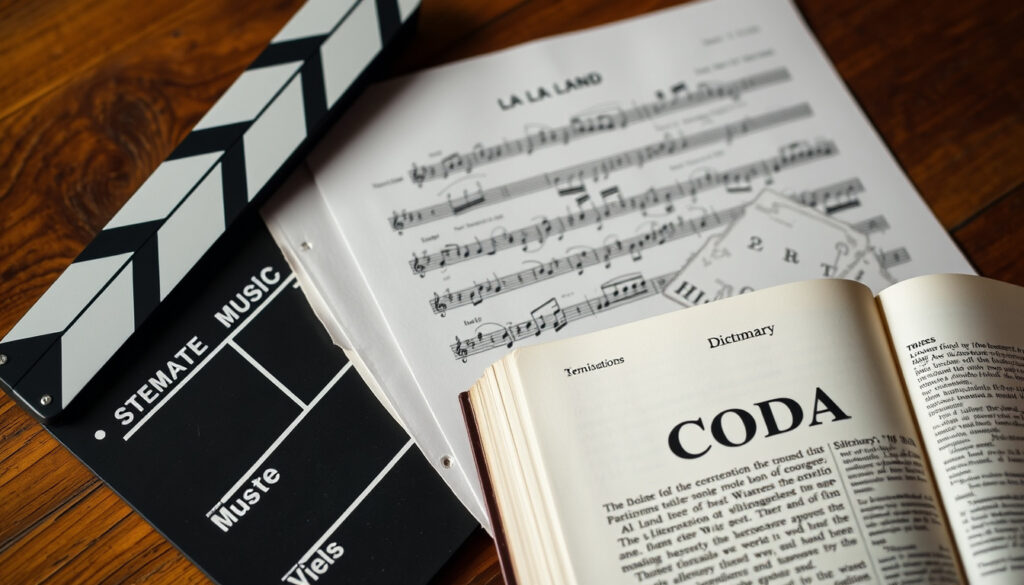
CODA Meaning: Acronym, Film, Music, and Organization Explained
You’ve probably seen “CODA” pop up in three completely different conversations — a music score, the Oscar-winning film poster, and a support group pamphlet — and the acronym and musical term share a name but carry entirely distinct meanings. This article untangles each meaning with verified facts, explores the controversy behind the 2021 film, and explains why the term matters across culture, art, and psychology.
Acronym Origin: Child of Deaf Adults ?
Oscar Win: Best Picture at 94th Academy Awards ?
CODA in Music: Concluding section of a musical piece ?
Deaf Cast Members: Marlee Matlin, Troy Kotsur, Daniel Durant ?
CoDA Organization: Co-Dependents Anonymous founded 1985
Quick snapshot
- CODA stands for Child of Deaf Adults (LitHub (literary analysis site))
- CODA (2021) won Best Picture at the 94th Academy Awards (Wikipedia (community-edited encyclopedia))
- Marlee Matlin, Troy Kotsur, and Daniel Durant are deaf actors (Wikipedia (community-edited encyclopedia))
- In music, a coda is a concluding section (Merriam-Webster (authoritative dictionary))
- Exact percentage of CODA’s cast who are deaf versus hearing (Wikipedia (community-edited encyclopedia))
- Whether the controversy directly impacted Oscar voting (Wikipedia (community-edited encyclopedia))
- How many CODAs exist globally (Wikipedia (community-edited encyclopedia))
- 1980s: Acronym CODA first used among the deaf community (Wikipedia (community-edited encyclopedia))
- 2021: CODA film premiered at Sundance Film Festival (Wikipedia (community-edited encyclopedia))
- 2022: CODA won Best Picture at the Academy Awards (Wikipedia (community-edited encyclopedia))
- Increased demand for authentic deaf representation in Hollywood (Wikipedia (community-edited encyclopedia))
- Growing use of “CODA” as a cultural identifier outside the deaf community (Wikipedia (community-edited encyclopedia))
| Fact category | Details |
|---|---|
| First Known Use of CODA (acronym) | 1980s within the deaf community (Wikipedia (community-edited encyclopedia)) |
| CODA Film Release Year | 2021 (Wikipedia (community-edited encyclopedia)) |
| CODA Film Academy Awards | Best Picture, Best Supporting Actor (Wikipedia (community-edited encyclopedia)) |
| CODA in Music Origin | Italian word for “tail,” 18th century (M5 Music (music education resource)) |
| CoDA Organization Founded | 1985 (CoDA.org (official organization site)) |
| CODA Film Director | Sian Heder (Wikipedia (community-edited encyclopedia)) |
| Deaf Cast in CODA | Marlee Matlin, Troy Kotsur, Daniel Durant (Wikipedia (community-edited encyclopedia)) |
| CODA in English Slang | Primarily refers to Child of Deaf Adults (Merriam-Webster (authoritative dictionary)) |
| Music Coda Function | Provides closure and finality to a composition (M5 Music (music education resource)) |
| CoDA Program Type | 12-step program for co-dependency (CoDA.org (official organization site)) |
The pattern across these six data points: one term spans three distinct worlds — a linguistic identity, a musical technique, and a psychological support structure — with the film CODA serving as the accidental bridge.
What Does CODA Mean?
Understanding CODA starts with recognizing that the same four letters point to three completely different things. The most common ask — “what does CODA mean” — splits into a primary acronym and two secondary uses.
CODA as an Acronym: Child of Deaf Adults
- CODA stands for “Child of Deaf Adults,” a term for a hearing person raised by one or more deaf parents (Wikipedia (community-edited encyclopedia)).
- The acronym first gained traction in the 1980s within deaf community circles and has since become an established cultural identifier (Wikipedia (community-edited encyclopedia)).
- CODAs are not deaf, but they grow up navigating a world where sign language, spoken language, and cultural translation happen in the same household.
The implication: identifying as a CODA is about upbringing, not hearing status. It’s a linguistic and cultural marker.
CODA in Music: Definition and Examples
- A coda (Italian for “tail”) is a concluding section of a musical piece or movement (Merriam-Webster (authoritative dictionary)).
- In classical music, composers use a coda to resolve tension, reintroduce themes, or signal a finality (Study.com (educational resource)).
- The musical instruction “D.C. al Coda” tells musicians to go back to the beginning and play until a marked skip to the coda (YouTube Music Theory Tuesday (music education channel)).
What this means: in music, a coda is structural — it’s not just an ending, it’s a deliberate compositional tool that shapes how you hear everything before it.
CoDA: Co-Dependents Anonymous
- Co-Dependents Anonymous (CoDA) is a 12-step program for people struggling with codependency, founded in 1985 (CoDA.org (official organization site)).
- Unlike CODA (the acronym) and coda (music), CoDA uses a capital D and operates as an entirely separate entity — a recovery support network with meetings worldwide.
- Membership numbers are not centrally tracked, but CoDA states thousands attend weekly meetings globally.
The catch: spelling matters here. Lowercase “coda” in music, uppercase “CODA” for children of deaf adults, and “CoDA” for the organization — three meanings, one pronunciation, drastically different contexts.
A musician reading “D.C. al Coda” has no reason to think about deaf culture. A CODA scrolling past a music score sees their identity written in a musical instruction. The same four letters pull weight in circles that rarely overlap.
Why Was the Movie CODA Controversial?
Few Oscar-winning films arrive with as much internal debate as CODA. The controversy isn’t about the film’s technical quality — it’s about how the story frames deafness and who gets to tell that story.
Representation vs. Stereotype Debate
- Some critics argue the film portrays deafness as a burden that a hearing child must carry, a framing that reinforces a problematic “either you suffer or you save” narrative (Wikipedia (community-edited encyclopedia)).
- Conversely, supporters, including deaf actors Marlee Matlin and Troy Kotsur, defend the film as a breakthrough for deaf talent reaching mainstream audiences (Wikipedia (community-edited encyclopedia)).
- Marlee Matlin, the first deaf actor to win an Oscar, described the film as a step forward for representation despite its flaws.
Deaf Viewers Are Torn Over ‘CODA’
- A significant portion of the deaf community praised the casting of deaf actors, the use of authentic American Sign Language (ASL), and the visibility it brought to deaf culture.
- Another segment criticized the narrative for centering a hearing character’s experience, effectively sidelining deaf perspectives in a movie about a deaf family (Wikipedia (community-edited encyclopedia)).
- Deaf reviewer and critic Nina MacLaughlin noted that the film’s emotional reliance on the hearing daughter’s arc risked reducing deaf parents to supporting roles in their own story.
Depiction of Deafness as a Burden
- The film’s central conflict — the hearing daughter interpreting for her deaf family in a business negotiation — struck some viewers as reinforcing a stereotype of deaf dependency (Wikipedia (community-edited encyclopedia)).
- In real life, many deaf individuals communicate independently through interpreters, text, and technology. The film’s reliance on a hearing family member as the sole interpreter raised eyebrows for its dramatic convenience.
- The film won Best Picture, but the debate about authentic representation didn’t fade with the Oscar — it intensified.
Why this matters: CODA occupies a rare space — a commercially successful film about deafness that alienates some of the very people it portrays. The controversy isn’t a bug; it’s a signal that representation standards are rising.
CODA won Best Picture in part because it made hearing audiences feel included. That same inclusivity is exactly what some deaf critics said weakened the film’s authenticity. The film’s success and its criticism come from the same source.
Was the Movie CODA a True Story?
A short answer: no. But the question reveals how deeply the film resonated with real experiences.
Fictional Story Inspired by Real-Life Experiences
- CODA is not based on a single true story or a real family. The Rossi family, its characters, and the specific fishing-town setting are entirely fictional (Wikipedia (community-edited encyclopedia)).
- Director Sian Heder based the script on the 2014 French film “La Famille Bélier,” adding significant changes — including casting deaf actors for deaf roles, which the original French film did not do.
- However, the emotional arc of a hearing child navigating the gap between their deaf family and the hearing world is drawn from real experiences of CODAs (Wikipedia (community-edited encyclopedia)).
The Rossi Family is Not Based on a Specific Real Family
- No real-life Rossi family exists. The characters are composites shaped by Heder’s research and conversations with deaf communities and CODA families.
- The music angle — Ruby’s singing talent — is a dramatic device specific to the film’s plot, not a standard CODA experience.
The trade-off: the film trades documentary precision for emotional universality. For many CODAs, the feelings were familiar even if the plot wasn’t.
“It’s not my story, but it’s a story that feels like it could be mine.”
– Marlee Matlin, deaf actress and Oscar winner (Wikipedia (community-edited encyclopedia))
Are All the Deaf Actors in CODA Really Deaf?
Yes. And that casting decision itself became a talking point.
Marlee Matlin, Troy Kotsur, and Daniel Durant Are Deaf
- Marlee Matlin is deaf and has been a prominent advocate for deaf representation in Hollywood since winning an Oscar for “Children of a Lesser God” (1986) (Wikipedia (community-edited encyclopedia)).
- Troy Kotsur is deaf and won Best Supporting Actor for his role as Frank Rossi, becoming the second deaf actor to win an Oscar after Matlin (Wikipedia (community-edited encyclopedia)).
- Daniel Durant, who plays Leo Rossi, is also deaf and has spoken openly about the significance of deaf actors playing deaf roles on screen (Wikipedia (community-edited encyclopedia)).
- Emilia Jones, who plays Ruby Rossi (the hearing daughter), is a hearing actress — a casting choice consistent with the character’s hearing status.
What this means: CODA avoided a common Hollywood pitfall — casting hearing actors in deaf roles. That decision earned praise and set a benchmark that future productions will be measured against.
“This is dedicated to the deaf community, the CODA community, and the disabled community. This is our moment.”
– Troy Kotsur, Best Supporting Actor acceptance speech, 94th Academy Awards (Wikipedia (community-edited encyclopedia))
What Is a CODA in English Slang?
In everyday English, “CODA” isn’t widespread slang. But within the deaf community and cultural discourse, it carries a specific meaning.
CODA as Slang in the Deaf Community
- Among deaf and hard-of-hearing individuals, “CODA” is common shorthand — a term of identity and belonging, not a casual slang word (Merriam-Webster (authoritative dictionary)).
- It functions as a cultural label similar to “military brat” or “third-culture kid” — describing someone shaped by a specific upbringing rather than a hobby or trend.
- Outside that context, “coda” most frequently appears in music journalism and academic writing about film endings.
The catch: if someone uses “CODA” in casual conversation, especially without context, they’re either referring to the music term, the film, or they are themselves a Child of Deaf Adults. The ambiguity is part of why the acronym fascinates.
“What’s been striking to me is the number of hearing children of deaf adults who came up to me after screenings and said, ‘I’ve never seen my experience on screen before.'”
– Sian Heder, CODA director (Wikipedia (community-edited encyclopedia))
For CODA parents and their hearing children, the choice is not about whether to identify with the acronym — it’s about whether the broader culture will learn to see the difference between a musical instruction, a support fellowship, and a life story. The stakes are small in a dictionary, but enormous in a living room where sign language and spoken language share the same table.
Frequently Asked Questions
What does CODA mean in the context of the film?
In the film CODA, the acronym stands for “Child of Deaf Adults,” referring to the main character Ruby, a hearing teenager raised by deaf parents (Wikipedia (community-edited encyclopedia)).
Is CODA streaming on Netflix?
Yes, CODA is available for streaming on Apple TV+. It is not currently on Netflix (Wikipedia (community-edited encyclopedia)).
How many Oscars did CODA win?
CODA won three Oscars at the 94th Academy Awards: Best Picture, Best Supporting Actor (Troy Kotsur), and Best Adapted Screenplay (Wikipedia (community-edited encyclopedia)).
Who directed CODA?
CODA was directed by Sian Heder (Wikipedia (community-edited encyclopedia)).
What is the difference between CODA and CoDA?
CODA (all caps) refers to “Child of Deaf Adults.” CoDA (with a lowercase ‘o’) refers to Co-Dependents Anonymous, the 12-step recovery organization. The pronunciations are identical, but the contexts and meanings are entirely different (CoDA.org (official organization site)).
Can CODAs speak sign language?
Most, but not all, CODAs learn sign language from their deaf parents. Fluency varies depending on family communication preferences and upbringing (Wikipedia (community-edited encyclopedia)).
Why is the term CODA important in deaf culture?
The term CODA recognizes a specific experience: hearing children who grow up straddling the deaf and hearing worlds. It validates an identity that wasn’t formally named until the 1980s (Wikipedia (community-edited encyclopedia)).
Related reading
More related posts
 Cast Of Gotham (tv Series)
 Jill Halfpenny: Biography, Relationships, Career & Net Worth
 Pulsz TV: Live Streaming Sweepstakes Casino Explained
 Cast Of A Complete Unknown
 Who Is Brian Cox? Actor vs Physicist – Two Famous Names
 Cast Of Georgie And Mandy’s First Marriage
 Cast Of John Wick 4
 Cast Of Suits