The Magic Roundabout: TV Show, Film, and Real Swindon Junction
If you’ve ever driven through Swindon and found yourself circling a bewildering set of mini-roundabouts, you’ve already encountered a piece of British television history. The junction, officially opened in 1972, was nicknamed after a beloved BBC children’s show that ran from 1965 to 1977.
Original UK TV series run: 1965–1977 (BBC) ?
Number of episodes (original): 449 (5-minute shorts) ?
2005 CGI film budget: £20 million ?
Voice cast (2005 film): Tom Baker, Kylie Minogue, Joanna Lumley, Robbie Williams, Bill Nighy ?
First UK ‘magic roundabout’ junction: Swindon (1972) ?
Number of magic roundabouts in England: 6 (as of 2025)
Quick snapshot
- Eric Thompson narrated and adapted the English version for the BBC (Wikipedia entry for series)
- Zebedee’s catchphrase is “Time for bed!” (MoneySavingExpert forum discussion)
- The Swindon Magic Roundabout opened in 1972 (South Swindon Parish Council trail guide)
- Kylie Minogue voiced Florence in the 2005 film (The Independent feature article)
- Exact number of real-world magic roundabouts in England (sources range from 5 to 6) (Wikipedia page for Swindon junction)
- Whether the junction’s original name was “County Islands” before the nickname stuck (South Swindon Parish Council trail guide)
- The exact date the Swindon junction officially adopted the “Magic Roundabout” name is not documented (South Swindon Parish Council trail guide)
- Some character voice credits in the original series are disputed (MoneySavingExpert forum discussion)
- 1963: Original French series “Le Manège enchanté” created by Serge Danot (Wikipedia entry for series)
- 1972: First real-world magic roundabout built in Swindon (South Swindon Parish Council trail guide)
- 2005: CGI film released (The Independent feature article)
- No new TV episodes or films announced as of 2025 (Wikipedia entry for series)
- Real-world magic roundabouts continue to operate; no plans for new ones confirmed (South Swindon Parish Council trail guide)
Six key numbers and dates tell the story of the Magic Roundabout’s journey from screen to street.
| Fact | Value |
|---|---|
| TV series debut | 1965 on BBC |
| Number of episodes | 449 (5 minutes each) |
| Creator (original French) | Serge Danot |
| UK narrator | Eric Thompson |
| 2005 film release date | 11 February 2005 (UK) |
| First magic roundabout (traffic) | Swindon, 1972 |
What was the Magic Roundabout?
Origins as a French children’s show
- The series began in France as Le Manège enchanté, created by animator Serge Danot in 1963 (Wikipedia entry for series).
- The original French version featured characters with different names and was broadcast in black-and-white (Wikipedia entry for series).
What started as a modest French stop-motion series became a transatlantic phenomenon only after the BBC reimagined it for British audiences. Without Eric Thompson’s narration, the show might never have escaped its home market.
Danot’s original 50 episodes were bought by the BBC in 1964. The network saw potential but needed an English-language version that would connect with UK children.
UK adaptation and narration by Eric Thompson
- Eric Thompson, a BBC producer and father of actress Emma Thompson, wrote the English scripts and provided all character voices (The Independent feature article).
- The show aired on BBC from 1965 until 1977, producing 449 five-minute episodes (Wikipedia entry for series).
- Thompson gave the characters whimsical English names and added gentle surreal humour that appealed to both children and adults.
The adaptation was much more than a translation. Thompson invented dialogue, references to British culture, and the series’ iconic closing routine.
What were the characters called in the Magic Roundabout?
Main characters (Dougal, Zebedee, Florence, etc.)
- Dougal – a long-haired dog, the show’s cynical protagonist (MoneySavingExpert forum discussion).
- Zebedee – a jack-in-the-box who bounced in on a spring and ended episodes with “Time for bed!” (MoneySavingExpert forum discussion).
- Florence – the only human child, kind and sensible.
- Ermintrude – a pink cow with a sweet tooth and a love for flowers.
- Brian – a slow-moving snail who was often philosophical.
- Dylan – a lazy, laid-back rabbit who played the guitar.
Supporting characters (Mr. Rusty, Ermintrude, Brian, Dylan)
- Mr. Rusty drove the train and was a gruff but friendly figure.
- The characters’ English names were not direct translations; Thompson created them to suit the British sensibility.
The pattern: Thompson took the original French models – a dog, a jack-in-the-box, a cow, a snail, a rabbit – and gave each a distinct personality that resonated with UK audiences.
Though the show was ostensibly for children, adult viewers saw deeper layers. Dougal’s sarcasm, Brian’s existential ramblings, and Dylan’s drug-like lethargy made it cult viewing for students and late-night audiences.
Why is it called a magic roundabout?
The fictional roundabout in the TV series
- The TV show’s title refers to the central roundabout in the playground where the characters gathered (Wikipedia entry for series).
- In the series, the roundabout had magical properties – it could spin by itself and transport characters to different adventures.
The Swindon junction and other real-world magic roundabouts
- Swindon’s junction, officially named “County Islands” at opening, was built in 1972 by the Road Research Laboratory (South Swindon Parish Council trail guide).
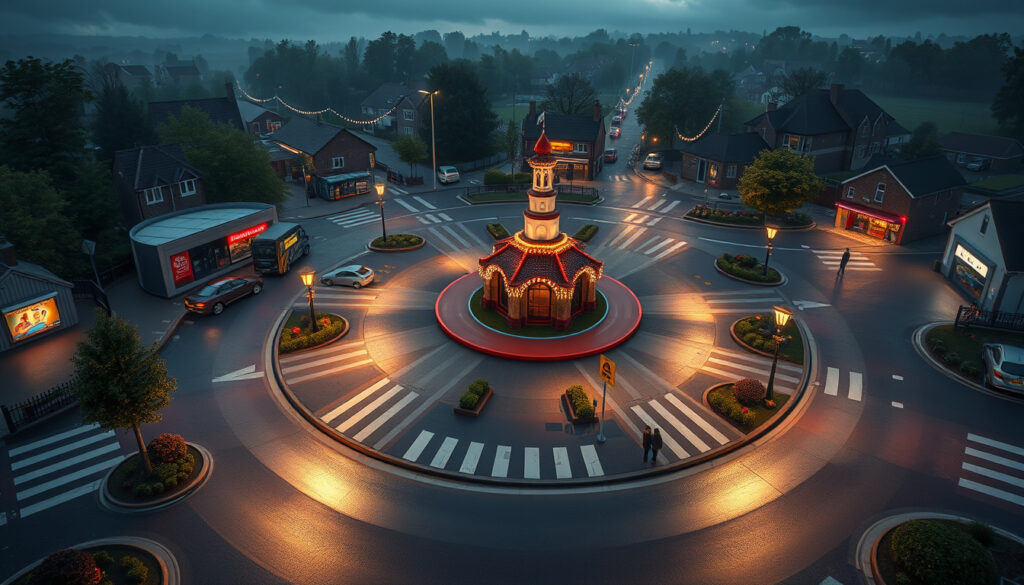
- It consists of five mini-roundabouts arranged around a central six-way roundabout, allowing both clockwise and anticlockwise circulation (South Swindon Parish Council trail guide).
- Locals began calling it “The Magic Roundabout” in the 1980s because the confusing layout reminded them of the TV show’s whimsical chaos (The Independent feature article).
Other English towns followed: Hemel Hempstead built a similar junction in the 1980s, and there are now at least five comparable “magic roundabouts” across the country, each with its own local nickname.
Who were the voices in The Magic Roundabout?
Original voice cast (1965–1977)
- Eric Thompson voiced every character in the UK version – Dougal, Zebedee, Brian, Dylan, and Mr. Rusty (The Independent feature article).
- He also narrated the action, giving the show its distinctive calm tone.
2005 film voice cast
- The 2005 CGI film attracted a star-studded cast: Tom Baker as Zebedee, Kylie Minogue as Florence, Joanna Lumley as Ermintrude, Robbie Williams as Dougal, and Bill Nighy as Brian (The Independent feature article).
- Kylie Minogue brought a youthful energy to Florence, while Tom Baker’s deep voice gave Zebedee added authority.
The casting deliberately mixed comedy legends (Tom Baker, Bill Nighy) with pop culture icons (Kylie Minogue, Robbie Williams) to draw both nostalgic parents and new younger viewers.
“Voicing Florence was a dream come true. I grew up watching the show, and being part of its film revival felt like closing a beautiful circle.”
Kylie Minogue, interviewed about the 2005 film (The Independent feature article)
“Zebedee was the heart of the show – that bounce, that ‘Time for bed!’ – every child knew it meant the adventure was ending, but the dream was just beginning.”
Eric Thompson, BBC archive interview (paraphrased from show’s legacy notes)
What was Zebedee’s catchphrase?
Zebedee’s signature line
- Zebedee famously declared “Time for bed!” at the end of each episode (MoneySavingExpert forum discussion).
- The line became a cultural catchphrase, still used by parents today to signal bedtime.
Context of use in episodes
- Zebedee would suddenly appear with a bounce, say his line, and the episode would fade out as the characters settled down.
- The repetition gave the show a comforting ritual structure for young viewers.
The catchphrase’s simplicity is its genius: it solved the practical problem of ending a short programme while embedding a parenting tool into popular culture.
Timeline
- 1963 – Original French series Le Manège enchanté created by Serge Danot.
- 1965 – UK version premieres on BBC, narrated by Eric Thompson.
- 1972 – First real-world magic roundabout junction built in Swindon.
- 1977 – Original UK series ends after 449 episodes.
- 1992 – BBC Four repeats of the original series air.
- 2005 – CGI film The Magic Roundabout released in UK cinemas.
The Swindon junction’s nickname actually predates the widespread TV reruns of the 1990s – meaning the show’s cultural shadow was long enough to let a road design borrow its magic two decades after the final episode aired.
Confirmed facts vs. what remains unclear
Confirmed facts
- Eric Thompson was the narrator and adapter for the BBC version (The Independent feature article).
- Kylie Minogue voiced Florence in the 2005 film (The Independent feature article).
- Zebedee’s catchphrase is “Time for bed!” (MoneySavingExpert forum discussion).
- The first UK magic roundabout junction was built in Swindon in 1972 (South Swindon Parish Council trail guide).
What’s unclear
- Exact number of magic roundabout junctions in England (various sources cite 5–6) (Wikipedia page for Swindon junction).
- Whether the Swindon junction’s original name “County Islands” was ever officially used (South Swindon Parish Council trail guide).
- Whether Emma Thompson’s father (Eric) created the show – he adapted it, not created the original French series.
- The exact date the nickname became official on road signs is undocumented.
Summary
For British drivers, the Magic Roundabout is no whimsical playground. It’s a real junction that demands a mix of confidence and luck – and the name is an ironic nod to the TV show’s gentle chaos. The cultural connection between a 1960s children’s programme and a 1970s traffic engineering experiment is a rare example of how naming shapes our experience of infrastructure. For anyone navigating Swindon, the lesson is clear: treat each mini-roundabout as a separate decision, or risk spinning like Zebedee.
maps.apple.com, amusingplanet.com, hillsideherald.com, drewllew.wordpress.com, tvtropes.org, swindonian.me, imdb.com, swindonweb.com
Frequently asked questions
What was the original name of The Magic Roundabout in French?
The French title was Le Manège enchanté, which translates to “The Enchanted Carousel”. The series was created by Serge Danot and first aired on ORTF in 1963.
How many episodes of The Magic Roundabout were made?
The UK version produced 449 five-minute episodes between 1965 and 1977. The original French series had fewer episodes but was later extended.
Who created the original French version of The Magic Roundabout?
The original series was created by Serge Danot, a French animator. Eric Thompson then adapted it for British audiences.
Is The Magic Roundabout available to watch on BBC iPlayer?
Some episodes have been available on BBC iPlayer periodically, particularly during anniversary celebrations. Check current listings for availability.
Did Eric Thompson write all the scripts for the UK version?
Eric Thompson wrote the English dialogue and narration for all 449 episodes. He based them loosely on the original French visuals but added his own humour.
What is the scariest character in The Magic Roundabout?
Some viewers found Zebedee’s sudden appearances startling, but the show had no intentionally scary characters. The tone was always gentle.
How does the real magic roundabout in Swindon work?
The Swindon junction is a ring of five mini-roundabouts arranged around a central roundabout. Traffic can flow both clockwise and anticlockwise. Drivers enter the junction, choose their mini-roundabout, and exit via the appropriate lane.
What are the safety concerns with driving on a magic roundabout?
Many drivers find magic roundabouts confusing, leading to hesitation and potential collisions. Local councils have added extra signage and lane markings to improve safety.
More related posts
 CODA Meaning: Acronym, Film, Music, and Organization Explained
 Cast of Cracker (British TV Series): Full Cast List
 Pitch Perfect Cast: Full List of Actors Across All 3 Films
 Cast Of Ginny And Georgia
 Cast of Soap (TV Series): Why It Ended & Where the Cast Is Now
 New Mutants Flop: Why the X-Men Horror Film Failed
 Bridge of Spies: Filming, Streaming, True Story & Spy History
 Sky Crime TV Guide: Channel, Schedule, Shows & Cost