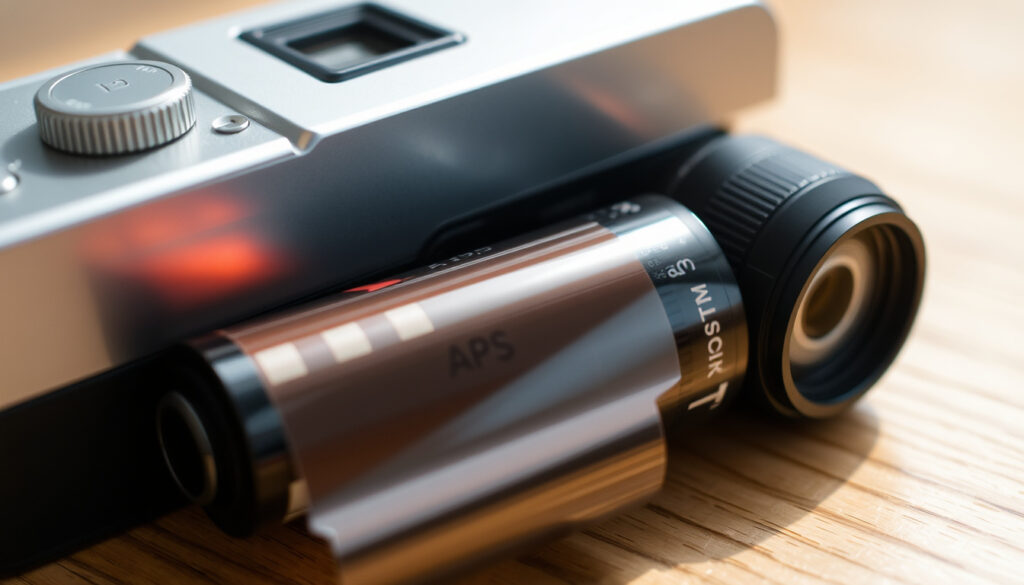
APS Film: Complete Guide to the Advanced Photo System (1996–2011)
If you’ve ever stumbled across a strange-looking plastic cartridge at a camera fair and wondered what it was, you’ve met APS film — the mid-1990s’ answer to making photography foolproof, backed by five of the biggest names in the industry. This guide covers what APS actually is, how it compares to 35mm, why it disappeared, and whether you can still shoot it today.
Introduced: 1996 ·
Discontinued: 2011 ·
Film width: 24 mm ·
Exposure sizes: H (16.7×30.2 mm), C (16.7×22.2 mm), P (16.7×10.5 mm) ·
Main manufacturers: Kodak, Fujifilm ·
Frame count options: 15, 25, 40, 50, 60
Quick snapshot
- APS stands for Advanced Photo System, launched in 1996 (Wikipedia).
- Film width is 24 mm with three aspect ratios: H, C, P (EverPresent).
- Production ended in 2011 by Kodak and Fujifilm (Wikipedia).
- Exact number of APS cameras sold worldwide remains unknown.
- Precise reasons why the format failed to achieve critical mass despite industry backing.
- Whether any manufacturing remains for niche industrial applications.
- 1996: APS launched globally by Kodak, Fujifilm, Canon, Minolta, and Nikon. (K2 photography)
- 2004: Fujifilm discontinues its APS films (K2 photography).
- 2011: Kodak stops APS production; end of all new manufacturing (Wikipedia).
- No new APS film is manufactured; only expired or new-old-stock remains. (The Darkroom Photo Lab)
- Specialty labs like The Darkroom still offer developing services (The Darkroom Photo Lab).
- APS cameras remain collectible but require careful handling of expired film. (The Darkroom Photo Lab)
The pattern is clear: APS prioritized simplicity over flexibility.
| Specification | Value |
|---|---|
| Full name | Advanced Photo System |
| Introduced | 1996 |
| Discontinued | 2011 |
| Film width | 24 mm |
| Aspect ratios | H, C, P |
| Cartridge type | Sealed, remains inside camera |
| Primary manufacturers | Kodak, Fujifilm |
| Typical frame counts | 15, 25, 40, 50, 60 |
What is APS film?
How does the Advanced Photo System work?
APS film — short for Advanced Photo System — was a consumer still-photography format first marketed in 1996 (Wikipedia). It was designed as a modern alternative to traditional 35mm film, aimed at making photography easier and more automated (EverPresent). The system used a cartridge-based design with a transparent magnetic coating for recording exposure information, known as IX (The Darkroom Photo Lab).
- The cartridge was a single-spool plastic unit about 39 mm long, and the film itself was 24 mm wide (EverPresent).
- APS offered three native image formats: C (Classic), H (High Definition), and P (Panoramic) (K2 photography).
- The APS C format is 25.1 × 16.7 mm, commonly described as a 3:2 aspect ratio similar to 35mm (Wikipedia).
- The APS H format is 30.2 × 16.7 mm, a 16:9 style frame (Wikipedia).
- The APS P format is 30.2 × 9.5 mm, a panoramic 3:1 frame (Wikipedia).
What are the key specifications of APS film?
The system was built around a sealed cartridge that remained inside the camera, protecting the film from light and dust. Typical frame counts included 15, 25, 40, 50, and 60 exposures. Film speeds were usually limited to ISO 100, 200, and 400.
APS was a closed ecosystem: the cartridge, the camera, and the processing equipment were all proprietary. For the casual user, that meant simplicity. For anyone wanting choice, it meant lock-in.
The implication: APS was a bold attempt to simplify photography, but its proprietary nature meant that when digital arrived, the entire system collapsed — there was no way to adapt it.
Is APS film the same as 35mm?
How does image quality compare between APS and 35mm?
APS film is physically smaller than 35mm. The standard 35mm negative measures 24×36 mm, while the largest APS frame (H) is only 16.7×30.2 mm (The Darkroom Photo Lab). That smaller negative area means less detail and more visible grain when enlarged.
- 35mm has a negative area roughly 70% larger than APS H format.
- APS cameras were generally more automated and compact, but at the cost of image quality.
- 35mm is still widely produced; APS is discontinued.
What are the physical differences?
APS uses a cartridge that retains the film at all times — you never handle the film strip itself. 35mm usually has a canister with a leader that you thread into the camera. The APS cartridge was designed for drop-in loading: you just inserted it and closed the back.
APS and 35mm serve different philosophies.
| Feature | APS | 35mm |
|---|---|---|
| Negative size (largest) | 16.7×30.2 mm (H) | 24×36 mm |
| Film width | 24 mm | 35 mm |
| Loading method | Drop-in cartridge | Manual leader threading |
| Aspect ratio options | 3 (H, C, P) | 1 (3:2, but can be cropped) |
| Current availability | Discontinued (expired only) | Widely produced |
The trade-off: APS gave you ease of use and mid-roll format switching, but you paid for it with a smaller negative, fewer film stocks, and a system that couldn’t survive the digital transition.
Why was APS film discontinued?
When was APS film officially discontinued?
APS was discontinued in 2011, with Kodak and Fujifilm identified as the last two manufacturers to stop production (Wikipedia). Fujifilm had already ended its APS film production in 2004.
What factors led to its decline?
The rise of digital photography drastically reduced demand for all consumer film formats, but APS was hit especially hard. It never achieved the mass adoption its backers expected. The proprietary system limited compatibility and repair options, and the cost per shot was higher than 35mm.
- APS had fewer film stocks available — only a few ISO ratings compared to 35mm’s wide range.
- Higher per-shot cost than 35mm.
- Proprietary cartridge and equipment (cameras, processing machines) meant fewer repair options.
- Scanners and developing services are rare today.
APS was designed to be the future of consumer photography. Instead, it became a cautionary tale: the more proprietary the system, the faster it becomes obsolete when the market shifts.
Why this matters: APS’s failure wasn’t just about digital — it was about a closed system that couldn’t adapt. When digital cameras offered instant feedback and no film costs, APS had no unique advantage left.
What are the disadvantages of APS film?
How does cost compare to 35mm?
APS film was always more expensive per shot than 35mm. The proprietary cartridge and specialized processing equipment meant higher manufacturing and development costs. Today, expired APS film sells for $10–30 per roll on secondary markets, with no guarantee of quality. Film stocks were limited to a few ISO ratings — typically ISO 100, 200, and 400.
What are the limitations in film selection?
There was no equivalent of the wide variety available for 35mm, from high-speed black-and-white to specialty slide films.
Upsides
- Drop-in loading — no threading required
- Mid-roll format switching (H, C, P)
- Compact camera bodies
- Magnetic data recording for exposure info
Downsides
- Smaller negative = less detail, more grain
- Fewer film stocks available
- Higher per-shot cost
- Proprietary system — limited repair options
- Rare developing services today
The catch: APS’s advantages — convenience and compactness — were real, but they came at the cost of image quality and long-term viability. For most photographers, 35mm offered a better balance.
Can I still buy APS film?
Where can I find expired APS film?
No new APS film is manufactured. The only sources are expired film on eBay, second-hand markets, and the occasional new-old-stock (NOS) roll found in old camera stores. Prices vary widely; expect $10–30 per roll for expired stock.
Are there any new old stock (NOS) options?
Fresh film may still surface in old camera stores or from collectors who bought in bulk. However, even unopened APS film has likely expired — the last rolls were produced in 2011. Storage conditions matter: film kept cool and dry will perform better.
For anyone buying expired APS film today, the gamble is real: you might get usable images, or you might get nothing. The Darkroom Photo Lab still offers APS developing, but warns that results vary with expired stock.
How to shoot and develop APS film today
- Source an APS camera and a roll of expired or new-old-stock film.
- Load the cartridge into the camera — it drops in and the camera seals it.
- Shoot the roll, checking the camera’s battery and light seals before use.
- Send the roll to a specialty lab like The Darkroom for developing.
- Scan or print your negatives once processed.
For the collector or curious photographer, the choice is clear: buy a few rolls, shoot them in a well-maintained APS camera, and send them to a specialty lab. Or stick with 35mm, where film is fresh, cheap, and widely available.
Timeline: The rise and fall of APS film
- 1996: Advanced Photo System launched worldwide by Kodak, Fujifilm, Canon, Minolta, and Nikon.
- 1996–2000: Hundreds of APS camera models released; peak popularity in late 1990s.
- 2000s: Digital cameras rapidly erode consumer film market; APS sales decline.
- 2004: Fujifilm discontinues its APS films (K2 photography).
- 2011: Kodak stops APS production; end of all new APS film manufacturing (Wikipedia).
- 2010s–present: APS becomes a niche collectible; limited processing via specialty labs.
APS had a 15-year run — roughly half the lifespan of a typical film format. Its decline accelerated as digital cameras hit the mass market around 2003–2005, and by 2011, the format was commercially dead.
Clarity: What we know and what we don’t
Confirmed facts
- APS film was discontinued in 2011 by Kodak and Fujifilm (Wikipedia).
- Film width is 24 mm; three aspect ratios H, C, P (EverPresent).
- APS uses a cartridge that stays inside the camera (The Darkroom Photo Lab).
- No new APS film has been produced since 2011 (Wikipedia).
What’s unclear
- Exact number of APS cameras sold worldwide.
- Precise reasons why the format failed to achieve critical mass despite industry backing.
- Whether any manufacturing remains for niche applications (e.g., industrial).
Quotes and perspectives
APS was a film format for consumer still photography launched in 1996 and discontinued in 2011.
— Wikipedia
Finding processing for APS film is difficult — it’s essentially a dead format now.
— Reddit user on r/AnalogCommunity
We still offer APS film developing. The cartridge protects the film from light and dust, which helps with older rolls.
— The Darkroom Photo Lab
Frequently asked questions
What is the difference between APS and 35mm film quality?
APS has a smaller negative area (16.7×30.2 mm at largest) compared to 35mm (24×36 mm), which means less detail and more visible grain when enlarged. 35mm also offers a much wider range of film stocks.
Can APS film be developed at home?
It’s possible but challenging due to the sealed cartridge. The film must be extracted in complete darkness, and standard developing tanks may not accommodate the 24 mm width. Specialty labs like The Darkroom are the safer option.
Are there any APS film cameras still in use?
Yes, but they require expired film and careful handling. Many APS cameras still function mechanically, but battery availability and light seals can be issues.
How much does APS film cost on the secondary market?
Expect $10–30 per roll for expired stock on eBay or from camera fairs. New-old-stock can cost more, but there’s no guarantee of usable results.
What does APS stand for?
Advanced Photo System.
How long does unprocessed APS film last?
If stored cool and dry, expired APS film can remain usable for years beyond its expiration date. However, results are unpredictable — color shifts and loss of sensitivity are common.
Is APS film better than 35mm for beginners?
Not anymore. APS was designed for beginners with its drop-in loading and automated features, but since it’s discontinued and film is expired, 35mm is a much more practical choice for learning.
Can I get APS film scanned to digital?
Yes, labs like The Darkroom offer scanning services. Some flatbed scanners with film holders can also handle APS frames, though dedicated APS scanners are rare.
Related reading
For anyone curious about film photography today, the lesson from APS is clear: convenience matters, but an open system that lets you choose your film, your camera, and your lab will outlast any proprietary format. Shoot 35mm for reliability, or shoot APS for the challenge — but know what you’re getting into.
More related posts
 Rainbow TV Show: Why It Ended and What Happened Next
 Cast Of 9-1-1
 Cast Of Black Bird
 Cast Of Black Panther (film)
 Kodak Gold 200: What It’s Good For, Speed, and Beginner Tips
 James McAvoy: Biography, Children, and 2025 Attack
 How to Watch Really TV: Channel, App, and Freeview Guide
Cast Of Rebel Ridge
How to Watch Really TV: Channel, App, and Freeview Guide
Cast Of Rebel Ridge